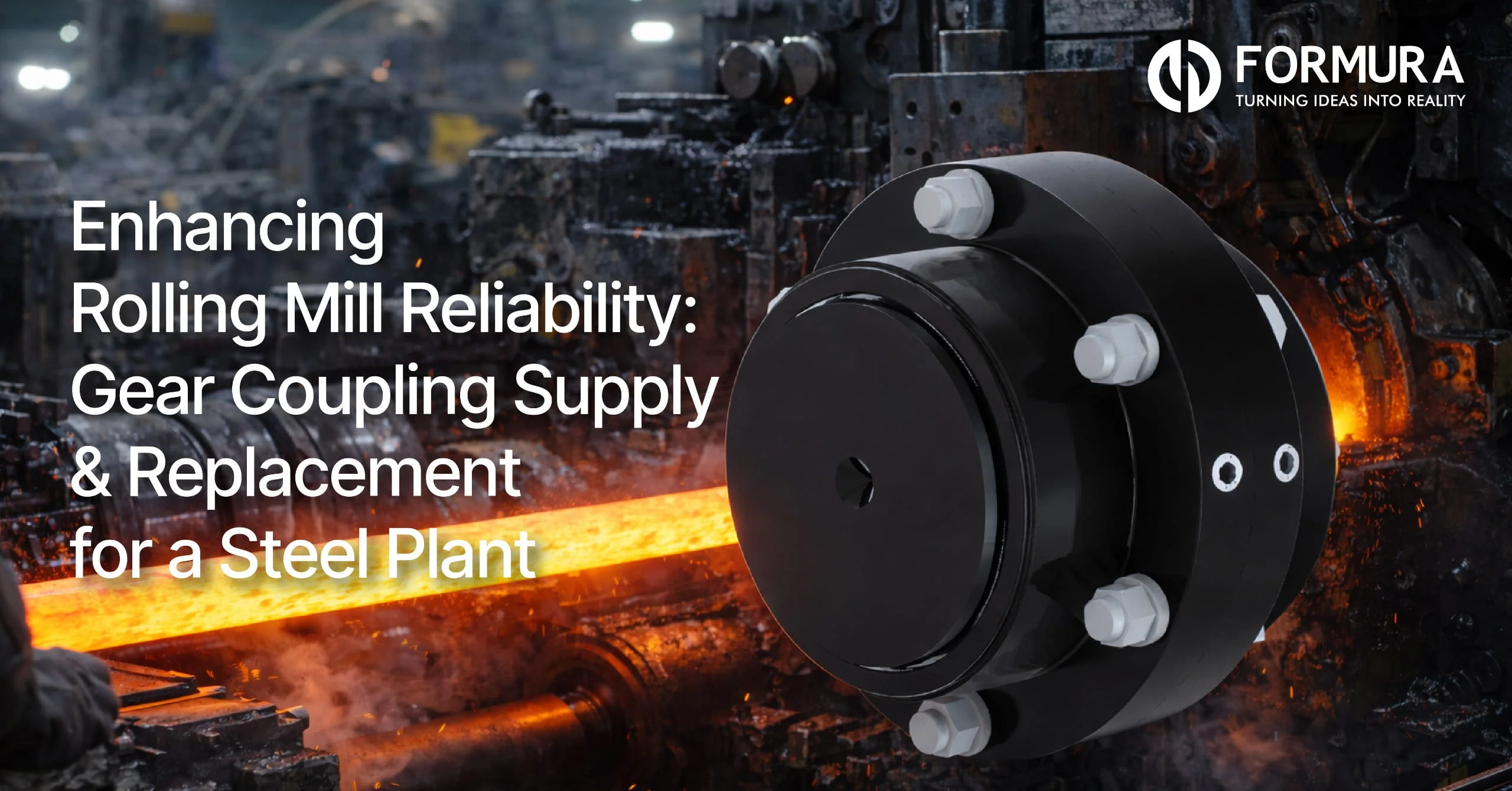
Enhancing Rolling Mill Reliability: Gear Coupling Supply & Replacement for a Steel Plant
Introduction
In the steel manufacturing industry, especially within rolling mills, consistent and reliable power transmission is the backbone of smooth operations. Any inefficiency in mechanical components like gear couplings can lead to production losses, increased maintenance costs, and unexpected downtime.
This case study outlines how a leading steel plant overcame persistent operational challenges through a strategic gear coupling replacement and engineering upgrade, ensuring improved reliability and long-term performance.
Background
The client operates a high-capacity rolling mill where torque transmission between the bevel gear and rolling mill machine is critical for continuous production.
However, the plant was facing recurring issues due to existing locally manufactured couplings, including:
- Frequent wear and tear
- Misalignment-related failures
- Inconsistent performance under load
- High maintenance frequency
- Risk of sudden breakdowns
The existing setup included:
- Vertical coupling (Model 103)
- Spacer type coupling (one side rigid, one side gear – Model 105)
- Spare coupling (FSV 75 series with mismatched hub sizes)
These inconsistencies in coupling configurations further added to operational inefficiencies.
Project Scope & Objectives
The primary objective of this project was to replace unreliable coupling systems with high-performance engineered solutions.
Key Objectives:
- Ensure reliable power transmission between connected equipment
- Minimize downtime and maintenance frequency
- Improve alignment tolerance and flexibility
- Enhance durability under high-load conditions
- Standardize coupling solutions across the system
Initial Enquiry
The client initially approached with a requirement for:
- Full Gear Coupling – Size EFG 108
However, after detailed discussions and evaluation, it was clear that the requirement extended beyond a simple replacement and required a holistic engineering solution.
Site Visit & Technical Assessment
A comprehensive site inspection and technical evaluation was conducted in coordination with the client’s team.
Client Representative:
- Rolling Mill Maintenance Manager
Assessment Highlights:
- Evaluation of existing coupling failures and wear patterns
- Analysis of shaft alignment and load distribution
- Identification of vibration and stress factors
- Compatibility issues with existing spare components
- Review of operational conditions and load cycles
This phase was crucial in identifying the root causes of recurring failures rather than just addressing surface-level issues.
Key Challenges
During the assessment, several critical challenges were identified:
1. Inconsistent Coupling Types
Multiple coupling models and configurations were being used, leading to:
- Poor compatibility
- Increased maintenance complexity
2. Misalignment Issues
Rigid and semi-rigid coupling setups were unable to handle:
- Angular misalignment
- Axial displacement
3. High Load Stress
Rolling mill operations involve heavy torque and fluctuating loads, which:
- Accelerated wear in local make couplings
- Reduced operational life
4. Improper Spare Utilization
Available spare coupling (FSV 75 series) had:
- Mismatched hub sizes
- Limited usability in actual operations
5. Frequent Downtime
Breakdowns and maintenance interruptions were impacting:
- Production schedules
- Overall efficiency
Engineering Solution
Based on in-depth technical discussions, drawing reviews, and site analysis, a multi-stage engineering solution was developed and implemented.
Proposed & Supplied Couplings:
- EFGSE-105
- EFGSE-105
- EFGSE-108
- FST-110
- EFG-104
- EFG-105
- EFG-108 (Full Gear Coupling)
Solution Strategy
Instead of a one-size-fits-all approach, the solution focused on:
✔ Flexible Coupling Integration
To accommodate:
- Misalignment
- Shock loads
- Operational vibrations
✔ Full Gear Coupling Deployment
For:
- High torque transmission
- Improved load distribution
- Longer service life
✔ Standardization
Reducing variation in coupling types for:
- Easier maintenance
- Better spare management
✔ Precision Engineering
Ensuring:
- Accurate fitment
- Improved shaft alignment
- Reduced stress on connected components
Implementation & Execution
The execution phase was carefully planned to ensure minimal disruption to operations.
Key Steps:
- Phased supply of couplings
- Coordination with maintenance team
- On-site installation support
- Alignment verification and testing
The structured approach ensured a smooth transition from old to upgraded systems.
Project Results
The implementation delivered significant operational improvements:
Enhanced Reliability
- Stable and consistent power transmission
- Reduced unexpected failures
Reduced Maintenance
- Lower frequency of breakdowns
- Simplified maintenance procedures
Improved Efficiency
- Better machine performance
- Reduced operational interruptions
Higher Durability
- Increased lifespan of couplings
- Better resistance to load and stress
Optimized Spare Management
- Standardized components
- Improved inventory control
Conclusion
This project highlights the importance of engineering-led problem solving in industrial environments.
Rather than simply replacing components, the focus was on:
- Understanding root causes
- Designing tailored solutions
- Ensuring long-term performance
Through a combination of technical expertise, precision engineering, and strategic execution, the steel plant achieved improved reliability, efficiency, and operational stability.
At FORMURA, we continue to deliver end-to-end engineering solutions that not only solve problems but also enhance performance and productivity across industries.