The Practical Guide to Jacking & Skidding: When should it be used
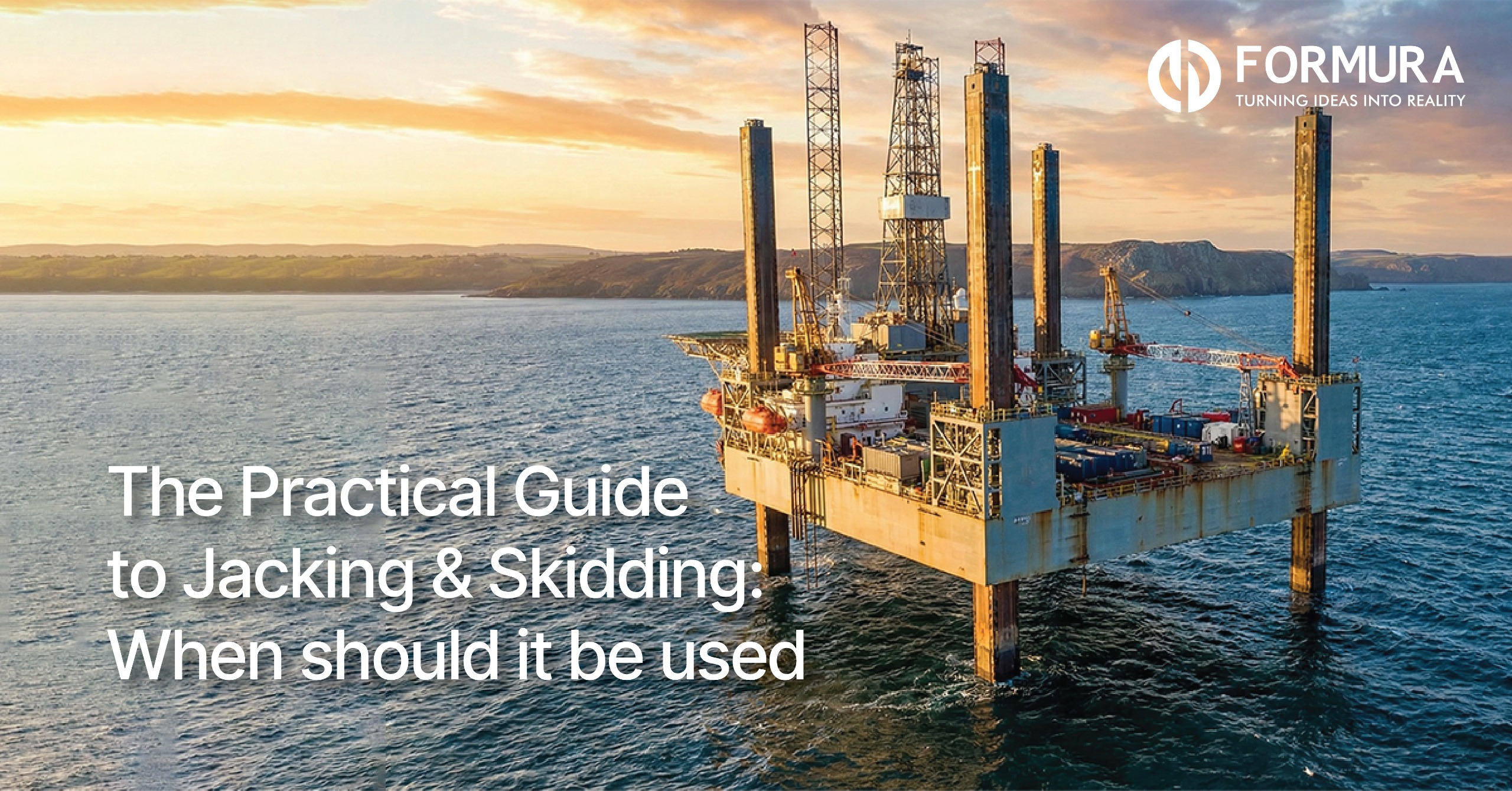
The Practical Guide to Jacking & Skidding: When to Use the Specialised Solution for Heavy Load Moving
The Problem with Tight Spaces
Imagine you need to replace a massive power transformer in a downtown utility vault, install a new press machine deep inside a factory, or reposition an engine block in a ship’s engine room. In each scenario, the equipment is huge and immensely heavy, while the space is the exact opposite: tight, restricted, and defined by low headroom lifting constraints.
The immediate thought is often a crane. But what happens when the crane won't fit? What if the lift is only a few inches high, or the object needs to travel 100 feet down a narrow hallway?
This poses the core challenge for heavy industries: How do you move a heavy load when a crane or self-propelled modular transporter (SPMT) is impractical or impossible to use?
The specialised answer is jacking and skidding. This dual-component system is the highly controlled, reliable solution for confined space lifting and heavy load moving, providing an essential alternative to a crane in a tight space. It is, in many ways, the ultimate indoor and low-clearance lifting solution.
Defining the Terms (The "What")
To understand the jacking and skidding process, you must first separate the two core actions: vertical lift and horizontal translation. They are often combined to form a complete jack and slide system.
1. Jacking: The Vertical Component
Jacking is the operation of raising a load off its foundation or supporting structure. This is accomplished using powerful hydraulic lifting tools, which include:
- Hydraulic Cylinders/Jacks: Standard, heavy-duty hydraulic jacks that push the load upwards.
- Climbing Jacks/Cube Jacks: Systems that use self-aligning, stackable steel blocks (or cribbing) to provide a mechanical lock beneath the load as it is continuously lifted in increments, eliminating the need for traditional wooden cribbing.
- Strand Jacks: Specialised jacks that use a hydraulic cylinder to pull steel cables (strands), capable of lifting enormous weights to significant heights, often used in large bridge or Offshore Jacking System Maintenance.
The vertical lift provided by a quality jacking system is the first critical step, enabling the rigging team to remove the old support or install the horizontal transport system underneath.
2. Skidding: The Horizontal Component
Skidding is the controlled process of sliding the load horizontally along a pre-laid path. It relies on two main parts:
- Skid Tracks (or Skid Beams): Guided steel tracks or beams placed beneath the load's travel path.
- Skid Shoes (or Slippers): These are structural blocks (often coated with a low-friction material like PTFE/Teflon) that are attached to the load. They sit directly on the skid tracks.
A hydraulic pusher unit, connected to the skid shoes, slowly and precisely pushes or pulls the load along the tracks. This assembly is universally known as a skidding system.
Also Read : Restoring Critical Jacking System Integrity Selecting the Right Jacking Systems for Industrial Applications
The Combined System
The brilliance of jacking and skidding is their synergy. The load is first jacked up just high enough to install the tracks and skid shoes underneath. It is then lowered onto the shoes and slowly pushed to its new location. For complex equipment lifting solutions, specialised providers like Formura offer full Jacking System Services that manage both the lift and the slide.
How It Works & Key Advantages (The "Why")
The jack and slide system is not just an alternative; it is fundamentally a different, and often safer, method of moving heavy equipment.
Core Principle: Controlled Friction and Safety
Unlike a crane, where the load is freely suspended and subject to dynamic forces like wind and swing, the load in a skidding system is always supported by the ground, the skid tracks, and the structural foundation.
The movement relies on a high-friction design between the shoes and the tracks. This ensures that the movement is:
- Slow and Controlled: Millimeter-by-millimeter precision is possible.
- Safe and Predictable: The load is only pushed in the intended direction by the hydraulic cylinder and will not "run away." This principle is why this method is so often favoured for delicate low-headroom lifting.
Key Advantages Table
| Works in Confined Spaces | The equipment has a very low profile and minimal setup footprint. It eliminates the need for the vast overhead clearance, boom radius, and counterweight space required by cranes. It answers the question, "How to move heavy machinery indoors?" |
| Precision & Control | Hydraulic synchronisation allows for millimeter-accurate positioning, which is vital for setting down large, sensitive equipment like turbines or generators onto foundation bolts. |
| Cost-Effective for Short Moves | While setup is required, the mobilization, setup, and rental costs for this system are often significantly lower than a large mobile crane, especially for a short-distance, heavy load moving project. |
| Enhanced Safety | The load is never freely suspended. This dramatically reduces the risk associated with load swinging, high winds, and rigging failure, making it one of the safest lifting solutions. |
When to Use It (The "When")
The choice between a crane and a jacking and skidding system boils down to the site constraints and the nature of the move.
Ideal Use Cases: An Alternative to Crane in Tight Spaces
The skidding system is the optimal choice in several specific scenarios:
- Indoor Equipment Relocation: Moving heavy equipment like manufacturing presses, injection moulding machines, or complex machine tools inside existing facilities with finished floors and low ceilings.
- Transformer & Generator Installation: Setting down or pulling out large electrical components in utility substations or power plants where structures and wiring create confined space lifting restrictions.
- Limited Headroom Projects: Any scenario where the overhead clearance is insufficient for a crane boom or gantry system. This is the definitive answer to what a skidding system is used for.
- Heavy, Low-Height Lifts: When a heavy load only needs to be raised a few inches to clear the floor and be moved horizontally, bringing in an enormous crane is inefficient and costly overkill.
The comprehensive Jacking System Services offered by providers like Formura are often specialised for these exact industrial and Offshore Jacking System Maintenance scenarios, where precision in tight spots is paramount.
Comparison with Cranes: The Decision Point
This specialised equipment doesn't replace cranes; it complements them. Here is a simple decision guide:
| High Vertical Lifts (e.g., placing a rooftop unit) | Low Headroom Lifting (e.g., inside a building) |
| Long Reaches (e.g., moving a load over a barrier) | Confined Space Lifting (e.g., narrow corridor access) |
| Open and Accessible Sites (where setup space is ample) | Precise Horizontal Positioning (millimeter-level accuracy needed) |
| Long Distance Transport (over large, uneven ground) | Short- to Medium-Distance, Straight-Line Moves |
Conclusion: The Strategic Tool
Jacking and skidding represent a strategic tool for modern heavy transport. It is the most reliable, precise, and often the only feasible equipment lifting solution for moving large, high-value assets in today's increasingly complex, constrained industrial environments.
For plant managers and project engineers grappling with how to move heavy machinery indoors or dealing with access-restricted sites, partnering with an experienced provider of Jacking System Services is essential. Formura, with its specialised knowledge in both jacking system design and field operations, delivers the controlled, safe, and efficient heavy load moving solutions that keep critical projects on schedule and minimise risk.